dynamicnetwork JSS Paper

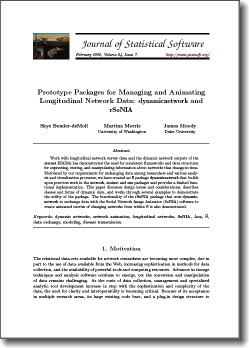
Well shoot, I guess it is publication week! The special issue of the Journal of Statistical Software about the statnet package for advanced network statistics has finally been released. It is great to see the years of hard work from everyone on the statnet team finally in print! I did some work for the project to hook up the package with SoNIA software to create movies from output of statistical models of dynamic networks of disease transmission. One of the articles in the issue documents the process and includes some example movies:
jssCover
Skye Bender-deMoll, Martina Morris, James Moody (2008) “Prototype Packages for Managing and Animating Longitudinal Network Data: dynamicnetwork and rSoNIA” Journal of Statistical Software. Vol. 24, Issue 7.

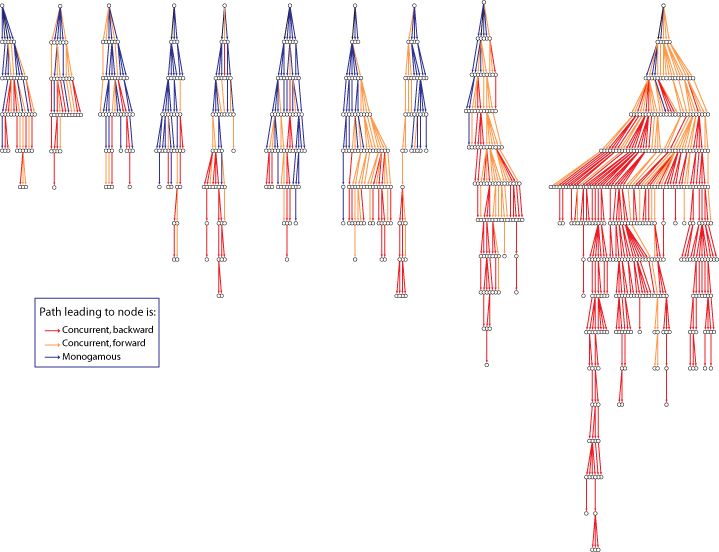
One of the exciting things for me about the project was exploring ways to display time, connectivity, and transmission simultaneously. An example of one of the movies demonstrating the effects of varying levels of “concurrent partnerships” on the paths of transmission of simulated “infection”: (70mb quicktime movie). In the last few frames of the movie, the perspective shifts to show a timeline image of the infection “trees” in occurring in the simulated network.

infection treesIn the tree image (created by James Moody) time advances vertically down the page, so the seed nodes for each infection appear at the top and the “depth” of the tree indicates the time step of the infection. The color of each edge indicates the concurrency status of the corresponding relationship when the transmission occurred.

Continue reading dynamicnetwork JSS Paper →

Bibliography on humanitarian and human rights uses of networks

This bibliography was collected while doing research for a report to the AAAS Science and Human Rights Program on Potential Human Rights Uses of Network Analysis and Network Mapping (pdf). The articles were located through my own (mostly web based) research and from the kind recommendations of the SOCNET listserv. Several of the cites are general network analysis lit, and not everything appeared in the paper. I’m sure there are many relevant articles I’ve overlooked, and I’m sorry if I left out anything someone sent me. The list is an export from my bibtext file, if anything got mangled in export, please let me know and I will send you the bibliography file.

Continue reading Bibliography on humanitarian and human rights uses of networks →

Network Mapping for Human Rights

[NOTE: as of 2013, AAAS network mapping is offline, links have been altered to point to Internet Archive versions]
Well, its several months overdue, but I finally finished my report to the AAAS Science and Human Rights Program on network analysis and mapping. The goal was to give a non-academic introduction to network concepts and related fields, survey some relevant academic and humanitarian projects, and make some proposals.

Potential Human Rights Uses of Network Analysis and Mapping:
A report to the Science and Human Rights Program of the American Association for the Advancement of Science
(pdf, 47p)
front page of network mapping report
The report also includes a number of visual examples (thanks to the authors for allowing me to include samples of their work). Also thanks to the members of the SOCNET listserv for recommendations. It was really great to have an opportunity to discover what work is being done, and dig up interesting data sets and applications (see grassroots network mapping, I’ll post others as well). At the same time, I’m sure there are a number of worthy and relevant projects that I have overlooked, so please contact me or SHRP with more examples.
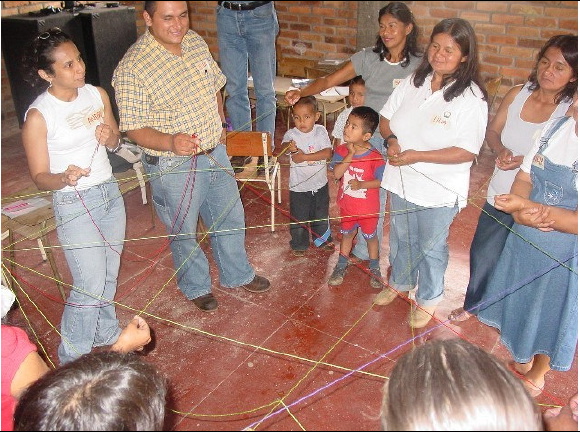
colombiaworkshop

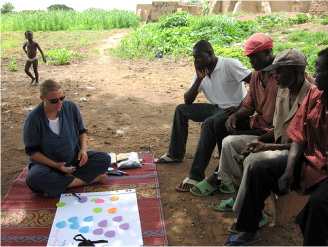
One lovely network visualization included was this above. It shows warm-up exercise for participants in a network mapping workshop for a Colombian farmer collective. Colored wool was used to represent the various communication paths by which participants received invitations to the workshop. (From B. Douthwaite, A. Carvajal, S. Alvarez, E. Claros, and L.A. Hernández. “Building farmers’ capacities for networking (Part I): Strengthening rural groups in Colombia through network analysis.” Knowledge Management for Development Journal, 2(2), 2006.

Fashionable Networks

Just found out that Oil Change’s follow the oilmoney tool got a little blurb in an Italian fashion/women’s magazine:

“D” la Repubblica delle Donne, March 8, page 52
dMagMarch8

Yup, that’s us in the upper left — if you can draw your eyes away from that purse. The juxtaposition brings up an interesting point. One of our goals was to try to put campaign funding data into more visually interesting and accessible form, try to catch people’s eye and interest so they will click in and learn something. Yet despite many months of work, what we produced looks clunky and amateurish next to a high-production fashion ad.

Perhaps this is OK — it would be pretty inappropriate to be using images of sexy women to sell campaign finance reform. But it does make me wonder if infographics really have any potential to compete for people’s media attention. Maybe we just need better designers.

In a more content-related direction, the site now has VoteTracker feature for showing how Congress-people voted on specific oil- and climate-related bills.

VoteTrackerTable
Continue reading Fashionable Networks →

Follow-the-oilmoney lives!

GWBush2000Galexy
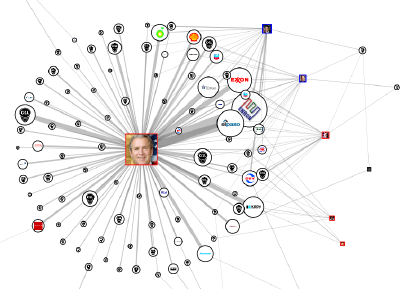
Well, it has not been officially launched yet, but the oil company campaign contribution site we’ve been working on for the last six months is live. It leaked out on blogs this week, and has been getting good reviews and tons of traffic. We are excited! The site is a project of Oil Change International and another collaboration between myself and Greg Michalec. It shows interactive network maps of campaign contributions to presidential races and members of congress. The same data is also shown in drillable tables, so you can go from a politician, to the contributing oil companies, all the way to the image of the original FEC filing. It also permits searching for congress members by name and constituent zip code.

Continue reading Follow-the-oilmoney lives! →

Grassroots network mapping

SchifferGhanaI’m working on a project for AAAS’s Science and Human Rights Program to identify some possibilities for human rights uses of networks and network visualization. In the process of doing a quick web review of existing work, I located a couple of interesting examples of people using networks as a grassroots tool to help stakeholders develop analysis of the power networks they are embedded in as a strategy tool. Also great to see such a low-tech solution.
Continue reading Grassroots network mapping →

Oil Change Web App Report


oilchange report cover

This document outlined some of the problems we ran into while building the Follow the Oil Money contribution network mapping application. It was written in November 2007, partially as a proposal, so many things changed in the real version. Also, most of the links are dead, as they pointed to an internal server. More info here.

An Interactive Web Application for viewing Oil Industry Contribution Network Data
Report to Oil Change International by Skye Bender-deMoll and Greg Michalec

giulianiGeoMap

Oil Networks, Advertising, Imaginary Data?

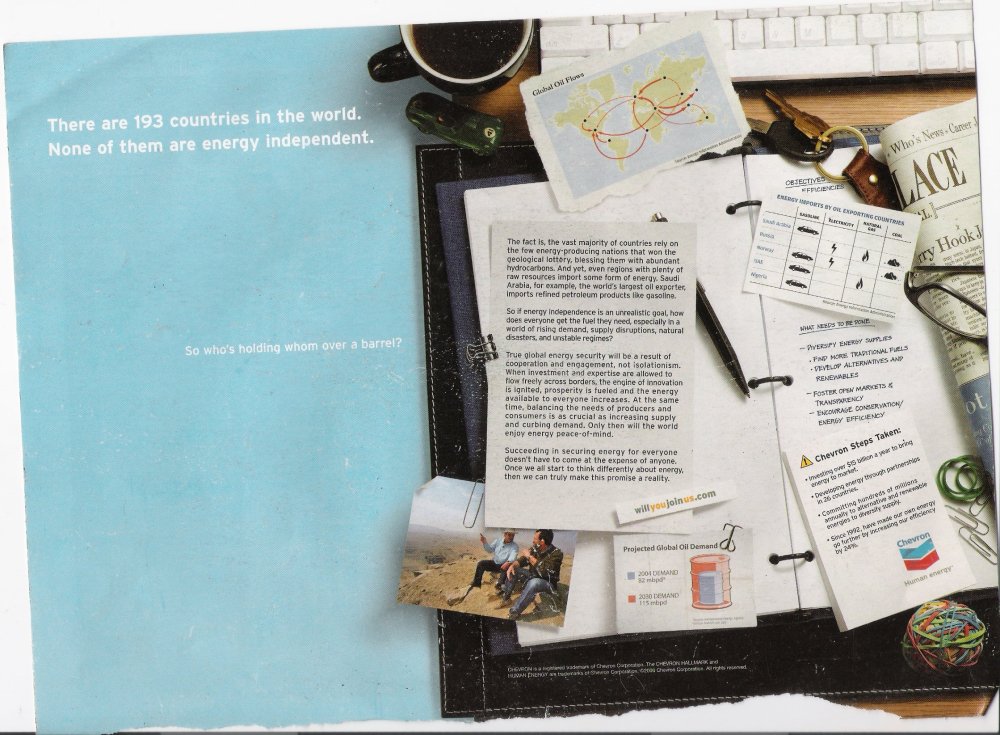
ChevronHarpersAdI found an interesting Chevron advertisement inside the back cover of the July 2007 issue of Harper’s magazine. Captioned “There are 193 countries in the world. None of them are energy independent.” it depicts an open notebook with clippings of a number of graphics and charts showing information about energy interdependence.
ChevronOilFlowMap
Continue reading Oil Networks, Advertising, Imaginary Data? →

Organic Brand Ownership Networks

organicNetworkCloseup
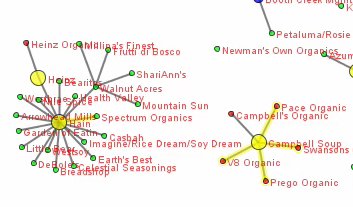
A friend of mine recently found a map of ownership relationships in the organic food industry pinned up in a neighbor’s kitchen. A bit of searching led us to Phil Howard‘s work tracking the growth and mergers of companies and brands. He kindly shared his data with me so we could use SoNIA to make a network animation showing major brand introductions and ownership relations from 1995 to 2007.
Continue reading Organic Brand Ownership Networks →

curiosities of culture, communication & networks